
Fact Sheet / Brief

View brief.
n early October 2023, nearly fifty research scientists and technicians collaborating with the USDA Forest Service-sponsored Fire and Smoke Model Evaluation Experiment (FASMEE) gathered on the Fishlake National Forest to collect measurements from a rare stand-replacing prescribed fire. Developing new approaches to predict fire and smoke behavior, scientists representing the USDA Forest Service, the National Aeronautics and Space Administration (NASA), Tall Timbers, Desert Research Institute, and universities from across the country, partnered to collect fire-related data from belowground to space. These synergistic research projects characterized fuels, measured radiant heat and energy, evaluated smoke concentrations, and documented fire effects on vegetation and even bats.
View brief.
For nearly 12 years, the Field Guide for Mapping Post-Fire Soil Burn Severity has provided BAER teams with consistent methodologies, tools, and terminology to quickly and accurately identify postfire conditions. RMRS Research Engineer Pete Robichaud and colleagues created the field guide, which is now available in Spanish.
View brief.
Imagine being able to take a bird’s eye view of the forest: you could see the forest structure, how the trees are grouped, the height and size of each tree in a matter of moments as you cruise over. You could fly over the stand today, then again next year and examine the effects of a treatment or a wildfire or an insect outbreak. Uncrewed aerial systems (UAS – aka drones) are starting to allow managers to do just that.
View factsheet and article.
It is not well understood whether desert plantings can facilitate recruitment of other natives (or mainly just non-natives), or whether facilitation changes through time as a restoration site matures. To address these uncertainties, we partnered with the National Park Service to study plant community change below planted perennials and in interspaces (areas between perennials) during 12 years (2009-2020) in Joshua Tree National Park, California, in the southern Mojave Desert.
View article and factsheet.
This study uses tree cores gathered at three 4-hectare plots to make inferences about temporal aspects of tree recruitment in pine-dominated ecosystems of the California Sierra Nevada and the Sierra San Petro Martir in northwestern Mexico.
View article and factsheet.
In California’s dry mixed conifer forests, increasingly large high severity wildfires threaten to convert significant areas of forested land into shrub dominated landscapes in the absence of active reforestation, including control of competing vegetation. Previous studies have found that salvage logging and other methods used to prepare a site for reforestation may reduce shrub cover after wildfire. This study investigated the effect of masticated fuel depth on shrub growth where salvage logging and mastication followed high severity wildfire.
View factsheet.
This report highlights recent science on primary threats to persistent woodlands, identifies the role of changing climate, and highlights new efforts and approaches to develop management strategies focusing on building pinyon-juniper woodland health and climate resilience.
View article.
Many tools that identify wildfire risks and hazards across the landscape assume that all houses and properties within a community have the same level of risk. However, there are often substantial differences across properties, such as building materials and distance to overgrown vegetation. Tools that don’t account for parcel-level risk cannot provide the details necessary for informing action on private property, such as maintaining defensible space, posting a visible address sign, or hardening a structure.
View article.
Colorado State University engineers have developed a model that can predict how wildfire will impact a community, down to which buildings will burn. They say predicting damage to the built environment is essential to developing fire mitigation strategies and steps for recovery.
View brief.
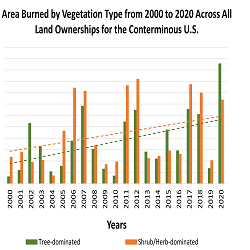
Wildfires burned more area on non-forested lands than forested lands over the past 20 years. This was true for all land ownerships in CONUS and the western US. Burned area increased over the 20-year time period for both non-forest and forest. Across CONUS, annual area burned was higher on non-forest than forests for 14 of the past 21 years (Fig. 1), and total area burned was almost 3,000,000 ha more in non-forest than in forest. For the western US, total burned area was almost 1,500,000 ha more in non-forest than in forest. From a federal agency perspective, approximately 74% of the burned area on Department of the Interior (DOI) lands occurred in non-forest and 78% of the burned area on US Forest Service (FS) lands occurred in the forest.