
Search Results: page/3/about%25252525252525253Ablank/about%253Ablank/about:blank
MLRA 23 – Malheur High Plateau
The Malheur High Plateau Major Land Resource Area (MLRA 23) includes portions of Nevada and California. The report linked below contains state and transition models (STMs) for 20 Disturbance Response Groups (including 99 Ecological Sites) within the MLRA.
MLRA 23 State and Transition Models Report (large file, be patient with the download).
Back to the STM main page.
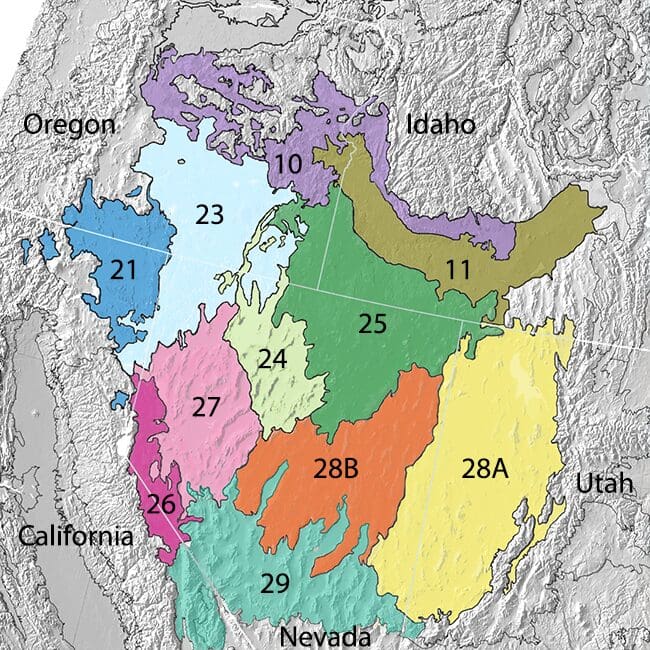
Major Land Resource Areas (MLRAs) located in and adjacent to the Great Basin Region: Central Rocky and Blue Mountain Foothills (10), Snake River Plains (11), Klamath and Shasta Valleys and Basins (21), Malheur High Plateau (23), Humboldt Basin and Range Area (24), Owyhee High Plateau (25), Carson Basin and Mountains (26), Fallon-Lovelock Area (27), Ancient Lake Bonneville (28A), Central Nevada Basin and Range (28B), and Southern Nevada Basin and Range (29) (derived from USDA-NRCS, cited in Miller et al. 2013, and updated with USDA-NRCS 2022 nomenclature). STMs have been created for all MLRAs but 11, 21, and 27 shown here.

Webinar recording (7:49)
The recent fires that swept the central and southern plains are catastrophic and exhibited extreme fire behavior. Fire behavior is a result of fuels, weather and topography and in this case the weather and fuels were extreme, and most importantly, the timing was just right. In this webcast, USFS, Research Ecologist Dr. Matt Reeves analyzes rangeland fuel conditions in the southern plains and keys in on the critical aspect of growing season position that is so influential to fire hazard. The conditions have to be just right to produce the type of outcomes witnessed in March and the high amount of standing dead grass (the minimum loading of herbaceous material in the fires we have seen to date was about 1200 pounds per acre on average), with no growth yet of green herbaceous material in the 2025 growing season permitted the extreme fire behavior across the region. All previous recordings are located on the Reading the Tea Leaves page.
View video.
It’s been a weird year so far. The west experienced an exceptionally cool and moist spring, especially in the southern extent of the region. Combined with above average snowpack, fuels stayed moist, and the fire season has had a very slow start. In fact, June saw the lowest area burned since 2000, but despite the slow start over 400 locations in the conterminous US have experienced record temperatures. Moreover, we have seen several weeks of anomalous heat waves, especially in the southwestern US. Yet still the fire season is slower than normal, but fuels are drying out fast.
In this 22-minute webcast, Research Ecologist Dr. Matt Reeves analyzes rangeland fuel conditions across the western US by evaluating the main factors of fuel amount and type, proximity to larger diameter fuel, drought conditions, and level of curing leading to senescent grasses in our simple but transparent hotspot algorithm. All 2022 recordings are located on the Reading the Tea Leaves page.
View recording.
In fire, fuels weather and topography mean everything. Fuels weather and topography and the timing of these components of the fire triangle must align properly for large fires to occur. Despite uncharacteristically large and continuous fuelbeds in numerous areas, however, it’s been a slow start to the fire season in the coterminous US.
In this webcast, Research Ecologist Dr. Matt Reeves analyzes rangeland fuel conditions across the West with an emphasis on how fire weather and rangeland fuels have not yet converged in 2023. All 2022 recordings are located on the Reading the Tea Leaves page.
Projections are based on Reeves’ Fuelcasting system – a component of the Rangeland Production Monitoring Service that provides projections of expected fuel conditions this grazing season.
- « Previous
- 1
- 2