

State and Transition Models for the Great Basin
The University of Nevada, Reno, Rangeland Ecology Lab, led by Dr. Tamzen Stringham, developed state and transition models (STMs) for Great Basin Major Land Resource Areas (MLRAs) to guide land management decisions by both public and private land owners. STMs are conceptual frameworks for organizing the current understanding of potential ecosystem changes caused by various disturbances or management and are often visualized as diagrams. They help explain complex ecological dynamics, like rangelands shifting due to drought or invasive species, to guide decisions about restoration or prevention.
Ecological Site Descriptions
Ecological sites are part of a land-type classification system that describes the ecological potential and ecosystem dynamics of land areas. An ecological site is defined as a distinctive kind of land with specific soil and physical characteristics that differ from other kinds of land in its ability to produce a distinctive kind and amount of vegetation and its ability to respond similarly to management actions and natural disturbances. Information and data pertaining to a particular ecological site are organized into a reference document known as an Ecological Site Description (ESD) that has the following information:
- Site Characteristics - physiographic, climate, soil, and water features
- Plant Communities – plant species, vegetation states, and ecological dynamics
- Site Interpretations – management alternatives
- Supporting Information – relevant literature and information.
State and Transition Models
Ecological Site Descriptions (ESDs) synthesize information concerning soils, hydrology, ecology, and management into a user-friendly document. A crucial component of an ESD is the state-and-transition model (STM) that identifies the different vegetation states (conditions), describes the disturbances that caused vegetation change (transitions), and suggests restoration activities needed to restore plant communities. State-and-transition models are powerful tools that utilize professional knowledge, data, and literature to describe the ecological dynamics of an ecological site (Briske et al. 2008, Stringham et al. 2003).
STMs are useful to management as they synthesize literature, professional, and local knowledge about individual ecological sites in order to distinguish changes in vegetation and soils that are easily reversible versus changes that are subject to thresholds beyond which reversal is costly or impossible. The models provide information needed to:
- Identify the different vegetation states and community phases
- Describe the transitions among states and the causal factors
- Define the management activities needed to restore plant communities.
Disturbance Response Groups
Ecological site descriptions have provided ecologically-based guidance for land management decisions for more than 60 years (Boltz and Peacock 2002), however the majority of utility has been realized on private lands primarily due to issues of scale. The spatial extent of individual ecological sites is determined through the correlation of sites to soil survey map units and provides a potentially valuable tool for management. Soil surveys are made by describing and classifying soils in the field and delineating their areas on maps, however different intensities of field study and degrees of detail in mapping are utilized by soil survey teams based upon the intended purposes for the soil survey. For rangeland applications, third-order soil surveys are conducted at the 1:24,000 – 1:63,360 scale and are appropriate for land uses that do not require precise knowledge of small areas or detailed soil information (Soil Survey Division Staff 1993). Therefore, it is not unusual to have multiple ecological sites correlated to one soil map unit.
Ecological sites have not been widely used by public land management agencies as a tool for management planning because they typically occur on the landscape at scales too small for landscape-scale decision making (Stringham et al. 2016). In an effort to remedy the issue of scale, Dr. Stringham led a team of scientists, professional land managers, and interested stakeholders in the development of a process that examines local knowledge, soil mapping data, and published literature on soils, plant ecology, plant response to various disturbances, disturbance history of the area, and any other important attributes necessary to sort pre-existing ecological sites into groups of ecological sites based on their responses to natural or human-induced disturbances (Stringham et al. 2003, Briske et al. 2008). These groups are referred to as Disturbance Response Groups (DRGs) and are defined as groups of ecological sites that respond similarly to disturbance, reaching the same state or end-point (although the rate of adjustment may vary by site) (Stringham et al. 2015a, 2015b). DRG’s simplify the landscape into ecologically significant units for management.
Major Land Resource Areas
Major Land Resource Areas (MLRAs) are geographically delineated regions developed by the USDA Natural Resource Conservation Service and are defined by distinctive geology, climate, soils, vegetation, water, and land uses (view map of MLRAs for the conterminous United States). MLRAs simplify complex topographic and climate variables that determine the presence of certain plants, animals, and water features. A map of MLRAs in and adjacent to the Great Basin is below.
There are eight Great Basin MLRAs with completed STMs linked below. Disturbance Response Groups were developed within each MLRA and the number per MLRA varies. Each Disturbance Response Group has one or more STMs. Click on an MLRA below to see its associated report of state and transition models.
MLRA 10 - Central Rocky and Blue Mountain Foothills
MLRA 23 - Malheur High Plateau
MLRA 24 - Humboldt Basin and Range Area
MLRA 26 - Carson Basin and Mountains
MLRA 28A - Ancient Lake Bonneville and 28B - Central Nevada Basin and Range
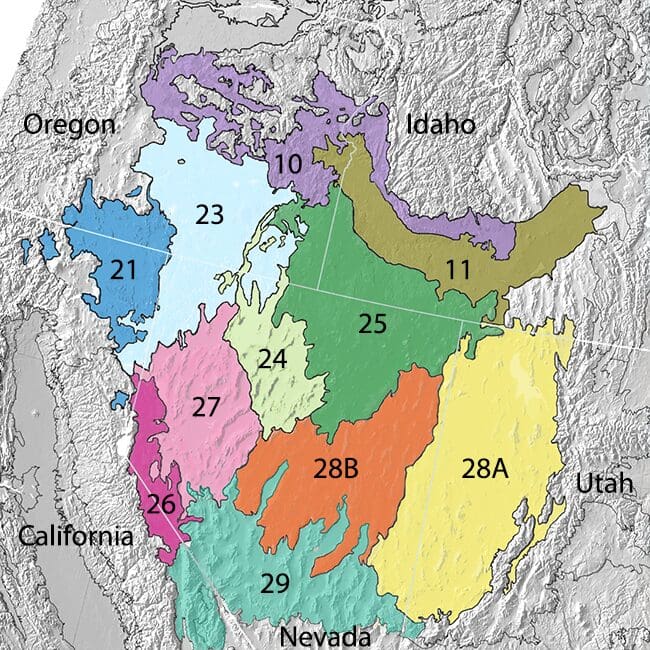
Major Land Resource Areas (MLRAs) located in and adjacent to the Great Basin Region: Central Rocky and Blue Mountain Foothills (10), Snake River Plains (11), Klamath and Shasta Valleys and Basins (21), Malheur High Plateau (23), Humboldt Basin and Range Area (24), Owyhee High Plateau (25), Carson Basin and Mountains (26), Fallon-Lovelock Area (27), Ancient Lake Bonneville (28A), Central Nevada Basin and Range (28B), and Southern Nevada Basin and Range (29) (derived from USDA-NRCS, cited in Miller et al. 2013, and updated with USDA-NRCS 2022 nomenclature). STMs have been created for all MLRAs but 11, 21, and 27 shown here.
Additional Reading
Stringham, T.K.; Novak-Echenique, P.; Snyder, D.K.; Peterson, S.; Snyder, K.A. 2016. Case study: Disturbance response grouping of Ecological Sites increases utility of Ecological Sites and State-and-Transition Models for landscape scale planning in the Great Basin. Rangelands. 38(6): 371-378.
Briske, D.D.; Washington-Allen, R.A.; Johnson, C.R.; Lockwood, J.A.; Lockwood, D.R.; Stringham, T.K.; Shugart, H.H. 2010. Catastrophic thresholds: A synthesis of concepts, perspectives, and applications. Ecology and Society. 15(3): 37.
Stringham, T.K.; Repp, J.P. 2010. Ecological Site descriptions: Consideration for riparian systems. Rangelands. 32(6): 43-48.
Briske, D.D.; Fuhlendorf, S.D.; Smeins, F.E. 2005. State-and-transition models, thresholds, and rangeland health: A synthesis of ecological concepts and perspectives. Rangeland Ecology and Management. 58(1): 1-10.
Stringham, T.K.; Krueger, W.C.; Shaver, P.L. 2003. State and transition modeling: An ecological process approach. Journal of Range Management. 56(2): 106-113.
Boltz, S.; Peacock, G. 2002. Ecological sites: Understanding the landscape. Rangelands. 24(5): 18-21.
More on Ecological Site Descriptions from the USDA-ARS Jornada Experimental Range: https://edit.jornada.nmsu.edu/catalogs/esd.
More on Ecological Site Descriptions and State and Transition Models from USDA-ARS Range Management Research at Las Cruses, New Mexico.