

Search Results:

View field guide.
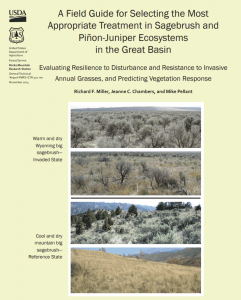
This field guide provides substantial evidence that pinon-juniper woodlands have experienced major expansion in their distribution since the late 1800s by encroaching into surrounding landscapes once dominated by shrubs and herbaceous vegetation. Both infilling and expansion affects soil resources, plant community structure and composition, water and nutrient cycles, forage production, wildlife habitat, biodiversity, and fire patterns across the landscape. Another impact is the shift from historic fire regimes to larger and more intense wildfires that are increasingly determining the future of this landscape.
View field guide.
This field guide identifies seven primary components that largely determine resilience to disturbance, as well as resistance to invasive grasses and plant succession following treatment of areas of concern. An evaluation score sheet is included for rating resilience to disturbance and resistance to invasive annual grasses and the probability of seeding success.
View guide.
This guide assimilates post-treatment vegetation and fuels data from Sagebrush Steppe Treatment Evaluation Project (SageSTEP) study sites across six Great Basin states into an assessment tool that can help managers better estimate percent cover, stem density and fuel loadings for post-treatment sites. The post-treatment Guide uses photographs and tables to provide the range of values for each vegetation type allowing users to quickly appraise a site by fuel stratum using an ocular estimate.
View guide.
This guide features 40 bird species that utilize sagebrush habitats and includes tips on species identification, biology, and conservation status. Because not all of these species require similar habitat types and not all sagebrush is managed for the same goals, this guide discusses how avian needs can be incorporated into land management plans.
Visit the website.
Around the world, woodlands and forests are replacing native grasslands and shrublands which impacts wildlife and people. In the sagebrush biome of the American West, pinyon pine, juniper, and other native conifer trees are expanding into imperiled shrublands. Learn more about the implications of this woodland encroachment and what communities are doing to restore healthy and resilient shrublands.

Webinar recordings.
- Monday, November 14 SCIENCE x Forests: Silviculture for the present and future
A compendium of silviculture treatments for forest types in the United States: Silviculture guidance to support modeling, scenario planning, and large-scale simulations, presented by Thomas Schuler
Prescribed burning considerations following mechanical treatments, presented by Sharon Hood
Reforestation in an era of megafires: A wicked problem for the Forest Service in Region 5 and elsewhere, presented by Martin Ritchie - Tuesday, November 15 SCIENCE x Forests: Forests and climate change
Preparing our forests for the future, presented by Mike Battaglia
The Pacific Northwest carbon dynamics research initiative: Co-production to assist land managers and policy makers, presented by Andrew Gray
Sink, swim, or surf: Surging climate change impacts and the role of climate-adaptive silviculture, presented by Alejandro Royo - Wednesday, November 16 SCIENCE x Forests: Innovations in forest research
From the forest to the faucet: Tools and data linking surface water from forested lands to public water systems, presented by Peter Caldwell
Cloud computing advances regional old-growth forest monitoring for the Northwest Forest Plan, presented by David M Bell
What is resilience in frequent-fire forests and how can it be measured?, presented by Malcolm North - Thursday, November 17 SCIENCE x Forests: Urban forestry, community, and wood utilization
The science and practice of urban silviculture, presented by Nancy Sonti and Rich Hallett
Expanding urban wood utilization, presented by Charlie Becker
Not by trees alone: Centering community in urban forestry, presented by Lindsay Campbell - Friday, November 18 SCIENCE x Forests: Invasion and outbreaks in forests
Species home-making in ecosystems: Toward place-based ecological metrics of belonging, presented by Susan Cordell
Invasion and outbreak within an epidemiological model, presented by Rima Lucardi
Mapping Armillaria-killed trees with high-resolution remote sensing, presented by Benjamin Bright
Webinar recording.
In the winter and spring of 2022, the National Forest Foundation (NFF), in coordination with the USDA Forest Service, hosted a series of roundtables across the country to gather input on the Wildfire Crisis Strategy Implementation Plan. The NFF distilled these productive discussions with Forest Service employees and partners into regional reports and an overall synthesis report, available at nationalforests.org/wildfire-roundtables.
The purpose of this webinar is to share more information about the report, discuss next steps, and provide an opportunity for Q&A with Forest Service leadership.

View article.
Five ethical lenses were generated from the thematic coding process: Epistemologies and Representation, Values and Priorities, Risk and Uncertainty, Power, and Metaethics. The five lenses provide a framework to identify prospective ethical tensions in wildland fire decision-making, both within and cutting across categories. This framework provides a way of structuring future investigations into wildfire ethics, as well as a starting point for developing techniques to integrate community and stakeholder values.
View article.
A slight, gradual decline in total C and N was found with increasing temperature and heat duration, reaching a maximum loss of 14–18% of the total at the highest heat load. Available NH4 increased linearly starting at 150–175 °C and reached a maximum 15-fold increase relative to unburned soil by 450 °C. Nitrification (30-d post-fire) was low regardless of treatment and was essentially eliminated at the highest temperatures. Microbial biomass declined curvilinearly with increased heating, approaching 65% loss compared to unburned soil, and was most rapid in moist soil once temperatures exceeded 60–70 °C. Ultimately, we found no evidence of abrupt heat thresholds for these common soil properties. Instead, property changes followed a slightly declining trajectory (soil C, N, NO3, fungal hyphae) or a steady incremental increase (NH4) or decrease (microbial biomass).