
Search Results: page/2/about%252525252525252525253Ablank/about%25252525252525253Ablank/about%252525252525253Ablank/about%2525252525253Ablank/about%25252525253Ablank/about%253Ablank

View report.
A group of people knowledgeable about wildland fire have produced a 52-page document that attempts to assemble and summarize areas of agreement and disagreement regarding the management of forested areas in the western United States. Calling themselves the Fire Research Consensus Working Group, they looked for areas of common ground to provide insights for scientists and land managers with respect to recent controversies over the role of low-, moderate-, and high-severity fires.

View available materials.
Oregon State University’s Citizen Fire Academy (CFA) program equips participants with the knowledge they need to improve fire preparedness and resiliency on their own properties and in their communities. This curriculum offers interested educators or agencies the teaching tools needed to conduct their own CFA program, including lesson plans, detailed agendas, tour ideas, and suggestions for presenting it as a hybrid course. The content is divided into six modules, with options to combine and separate the modules to fit the needs of the CFA facilitator.
Readers can download the entire 154-page curriculum as a single PDF or they can access individual sections. The single-PDF version of the publication includes hyperlinks to all references and resources, and includes an interactive Table of Contents for easy navigation to specific sections. In addition, corresponding PowerPoint presentations, worksheets, and handouts can be downloaded individually.
MLRA 10 – Central Rocky and Blue Mountain Foothills, including Crooked River National Grassland
The Central Rocky and Blue Mountain Foothills Major Land Resource Area (MLRA 10) includes portions of Oregon and Idaho. The report linked below contains state and transition models (STMs) for eight Disturbance Response Groups (including 98 Ecological Sites). STMs were also developed for the USFS Crooked River National Grassland within MLRA 10. That report contains STMs for four Disturbance Response Groups (including 18 Ecological Sites).
MLRA 10 State and Transition Models Report
USFS Crooked River National Grassland State and Transition Models Report
(large files, be patient with the download)
Back to the STM main page.
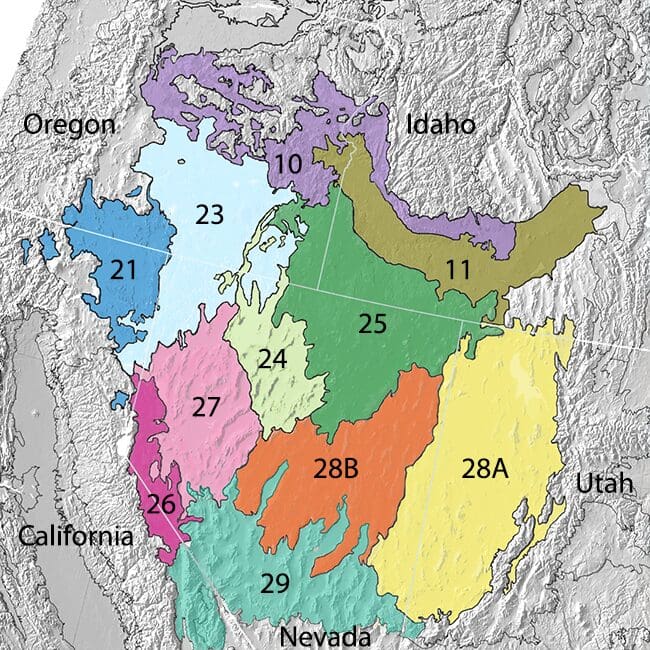
Major Land Resource Areas (MLRAs) located in and adjacent to the Great Basin Region: Central Rocky and Blue Mountain Foothills (10), Snake River Plains (11), Klamath and Shasta Valleys and Basins (21), Malheur High Plateau (23), Humboldt Basin and Range Area (24), Owyhee High Plateau (25), Carson Basin and Mountains (26), Fallon-Lovelock Area (27), Ancient Lake Bonneville (28A), Central Nevada Basin and Range (28B), and Southern Nevada Basin and Range (29) (derived from USDA-NRCS, cited in Miller et al. 2013, and updated with USDA-NRCS 2022 nomenclature). STMs have been created for all MLRAs but 11, 21, and 27 shown here.

View presentation (23:42).
Targeted grazing presents a great opportunity for managing fuels in rangeland environments. However, there numerous considerations that must be thought through and discussed prior to implementation. Issues such as poisonous plants, livestock acclimation, phenology, and nutritional concerns are among the list discussed in this episode. In this webcast, Research Ecologist, Matt Reeves discusses these issues and a decision support system aimed at improving strategic and prioritized targeted grazing across the U.S. West. For previous episodes, visit the Reading the Tea Leaves page.
Webinar recordings.
Monday, December 6: Forest and Rangeland Livelihoods
Leveraging demand for renewable energy and innovative bioproducts to facilitate forest restoration, presented by Nate Anderson
What happened to wood products markets in 2020 and 2021 in the United States?, presented by Jeff Prestemon
Managing wolves and livestock on national forests in the West, presented by Susan Charnley
Tuesday, December 7: Protecting Ecosystem Services
Human ecology mapping: Capturing diverse forest benefits and landscape interactions for use in planning and decision-making, presented by Lee Cerveny
What’s a canopy worth? Using i-Tree to understand the value of trees, presented by Alexis Ellis
Agroforestry: Tools for working across the landscape, presented by Gary Bentrup, Kate MacFarland, Matthew Smith, Richard Straight
Wednesday, December 8: Bounty Beneath Our Feet
Why is biochar so important?, presented by Debbie Page-Dumroese
Establishing pollinator habitat in log landings after timber sales begins with restoring the soil, presented by John Kabrick
Soil organic carbon, presented by Andy Coulter and Stephanie Connolly
Thursday, December 9: Urban Interfaces
A shared stewardship approach to wildland fire mitigation in Eastern Oklahoma, presented by Cassandra Johnson Gaither
Urban forestry, presented by Natalie van Doorn
Fire WUI urban communities, presented by Francisco Escobedo
Friday, December 10: Getting Outside
Managing winter recreation and sensitive species on Colorado’s public lands: Do humans and Canada lynx select the same habitat?, presented by Lucretia Olson
Considering the benefits of recreation in program reporting and decision-making, presented by Eric White
Latinix outdoor recreation, presented by Jose Sanchez
MLRA 29 – Southern Nevada Basin and Range
The Southern Nevada Basin and Range Major Land Resource Area (MLRA 29) is located in Nevada and includes the adjacent southeastern border of California and the southwestern corner of Utah. The report linked below contains state and transition models (STMs) for 32 Disturbance Response Groups (including 112 Ecological Sites) within the MLRA.
MLRA 29 State and Transition Models Report (large file, be patient with the download)
Back to the STM main page.
Major Land Resource Areas (MLRAs) located in and adjacent to the Great Basin Region: Central Rocky and Blue Mountain Foothills (10), Snake River Plains (11), Klamath and Shasta Valleys and Basins (21), Malheur High Plateau (23), Humboldt Basin and Range Area (24), Owyhee High Plateau (25), Carson Basin and Mountains (26), Fallon-Lovelock Area (27), Ancient Lake Bonneville (28A), Central Nevada Basin and Range (28B), and Southern Nevada Basin and Range (29) (derived from USDA-NRCS, cited in Miller et al. 2013, and updated with USDA-NRCS 2022 nomenclature). STMs have been created for all MLRAs but 11, 21, and 27 shown here.
MLRA 28A – Ancient Lake Bonneville (previously Great Salt Lake Area), and MLRA 28B – Central Nevada Basin and Range
The Ancient Lake Bonneville (previously called the Great Salt Lake Area) Major Land Resource Area (MLRA 28A) occupies a large part of western Utah and narrow portions of Nevada and Idaho. The Central Nevada Basin and Range MLRA (28B) occupies a large portion of central Nevada. The report linked below contains state and transition models (STMs) for 38 Disturbance Response Groups (including 170 Ecological Sites) within the MLRAs.
MLRA 28A and 28B State and Transition Models Report (large file, be patient with the download)
Back to the STM main page.
Major Land Resource Areas (MLRAs) located in and adjacent to the Great Basin Region: Central Rocky and Blue Mountain Foothills (10), Snake River Plains (11), Klamath and Shasta Valleys and Basins (21), Malheur High Plateau (23), Humboldt Basin and Range Area (24), Owyhee High Plateau (25), Carson Basin and Mountains (26), Fallon-Lovelock Area (27), Ancient Lake Bonneville (28A), Central Nevada Basin and Range (28B), and Southern Nevada Basin and Range (29) (derived from USDA-NRCS, cited in Miller et al. 2013, and updated with USDA-NRCS 2022 nomenclature). STMs have been created for all MLRAs but 11, 21, and 27 shown here.
MLRA 26 – Carson Basin and Mountains
The Carson Basin and Mountains Major Land Resource Area (MLRA 26) occupies a portion of western Nevada and adjacent border of California. The report linked below contains state and transition models (STMs) for 25 Disturbance Response Groups (including 95 Ecological Sites) within the MLRA.
MLRA 26 State and Transition Models Report (large file, be patient with the download)
Back to the STM main page.
MLRA 25 – Owyhee High Plateau, including an STM for Riparian Areas in the Northern Great Basin Region
The Owyhee High Plateau Major Land Resource Area (MLRA 25) occupies the northeast corner of Nevada and also includes portions of southern Idaho, Oregon, and northwestern Utah. The report linked below contains state and transition models (STMs) for 17 Disturbance Response Groups (including 36 Ecological Sites) within the MLRA. Also included is an STM for riparian areas in the northern Great Basin.
MLRA 25 State and Transition Models Report
Riparian State and Transition Model for the Northern Great Basin
(large files, be patient with the download)
Back to the STM main page.
Major Land Resource Areas (MLRAs) located in and adjacent to the Great Basin Region: Central Rocky and Blue Mountain Foothills (10), Snake River Plains (11), Klamath and Shasta Valleys and Basins (21), Malheur High Plateau (23), Humboldt Basin and Range Area (24), Owyhee High Plateau (25), Carson Basin and Mountains (26), Fallon-Lovelock Area (27), Ancient Lake Bonneville (28A), Central Nevada Basin and Range (28B), and Southern Nevada Basin and Range (29) (derived from USDA-NRCS, cited in Miller et al. 2013, and updated with USDA-NRCS 2022 nomenclature). STMs have been created for all MLRAs but 11, 21, and 27 shown here.
MLRA 24 – Humboldt Basin and Range Area
The Humboldt Basin and Range Major Land Resource Area (MLRA 24) is mainly located in Nevada but includes a small portion of Oregon. The report linked below contains state and transition models (STMs) for 12 Disturbance Response Groups (including 47 Ecological Sites) within the MLRA.
MLRA 24 State and Transition Models Report (large file, be patient with the download)
Back to the STM main page.
Major Land Resource Areas (MLRAs) located in and adjacent to the Great Basin Region: Central Rocky and Blue Mountain Foothills (10), Snake River Plains (11), Klamath and Shasta Valleys and Basins (21), Malheur High Plateau (23), Humboldt Basin and Range Area (24), Owyhee High Plateau (25), Carson Basin and Mountains (26), Fallon-Lovelock Area (27), Ancient Lake Bonneville (28A), Central Nevada Basin and Range (28B), and Southern Nevada Basin and Range (29) (derived from USDA-NRCS, cited in Miller et al. 2013, and updated with USDA-NRCS 2022 nomenclature). STMs have been created for all MLRAs but 11, 21, and 27 shown here.